English
 Français
 Deutsch
 Español
 Italiano
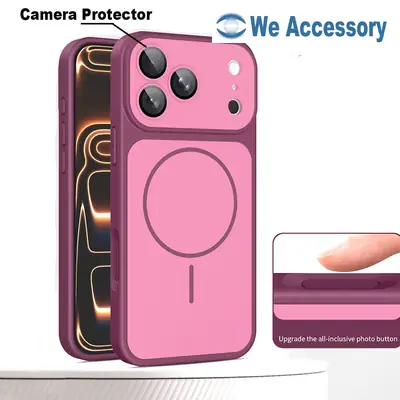
iPhone 18 Pro Max Skin-feeling magsafe case Matte case with build-in camera protection

Recommend Products
-
-
 iPhone Duo 360° rotating ring holder case N52 2300 Gauss strong magentic stand case
-
 iPhone 18 Pro Clear Magsafe Case build-in camera protector transparent magnetic case
-
 iPhone Duo Matte Magsafe Case Skin-Feeling N52 Strong Magnetic 2in1 Foldable Case
-
 iPhone 18 accessories iPhone 18 Pro 3in1 magnetic holder case camera holder ring holder case
-
 iPhone 18 Pro magsafe holder case glass camera protection and foldable holder case
-
 New trend iPhone 18 Pro matte skin-feeling magsafe case ring holder phone holder case
-
 Hot phone accessories iPhone 18 Pro magnetic stand phone case foldable phone holder case
-
 New iPhone 18 Accessories iPhone 18 Pro Ring Holder Case Camera protection Magsafe Case
-
 iPhone 18 Pro Max Card Holder Case Magsafe Holder Case Slide Window Camera Protection
-
 New design iPhone 18 Pro TPU+PC Hybrid Suitcase-Style MagSafe Shatterproof Case
-
 Business demeanor iPhone 18 Pro magsafe leather case 2in1 iphone cover luxury iphone case
-
 New iPhone Accessories iPhone 18 Pro Clear Magsafe Case double color 2in1 shatterproof case
-
 iPhone Case Distributor Newest iPhone Duo Case TPU+PC 2in1 Full Protective iPhone Case
-
 Phone Accessories Company New iPhone 18 Pro Case Magsafe Case with Phone Holder
-
 Phone Case Manufacturer New iPhone 18 Pro Max Armor Case Camera Protection and Holer
-
 iPhone 18 Accessories Supplier Newest iPhone 18 Pro Case Wholesale Matte magsafe case
-
 iPhone 18 Pro Case Wholesale Colorful Transparent Magsafe Case New iPhone 18 Pro Case
-
 Wholesale iPhone 17 Jelly 2 in 1 Magsafe Case colorful silicone iphone case
-
 Apple iPhone Case Supplier Colorful iPhone 17 electroplated case so cool case
Product Tags
Phone Case Manufacturer dont tell you Why Batch Two Never Matches Batch One
November 18, 2026
A chain in southern Germany sent back 1,200 pieces in September. Their message was four words long and it was not a question: the red is different.
I had the batch and the previous batch in the office, so I did the thing I should have done three years earlier and measured both against the standard we keep for that model. The difference came out at 4.06 by the old formula and 2.15 by the current one. Two point one five is roughly the line where a colour stops being the same colour to somebody who is paying attention.
The buyer was right, in other words. Not because the factory had been careless, and not because anyone had swapped a pigment, but because the colour had never been written down anywhere. There was no standard we both held, no tolerance, no formula and no light under which anyone had agreed to look. We had been matching against a photograph and a memory, which is not a specification, it is a hope.
This article is about the most common and least discussed defect a phone case manufacturer ships. Not cracks, not yellowing, not fit. Colour. The thing that comes back in every third complaint email, that nobody measures, and that is almost entirely fixable with a piece of paper and a number.
Colour is the only specification nobody writes down
Think about what a phone case quotation contains. Material, hardness, thickness, wall dimensions, tolerance bands, magnet grade, finish, packing, MOQ, price. Every one of those is a number with a unit, except the one that decides whether the retailer can put the case on the shelf next to the one they bought last season.
On a phone case manufacturer quotation the colour line, when it exists at all, says something like "red", or "same as sample", or "Pantone 186 C". The first is meaningless. The second is a memory, and memories are not transferable between a factory, a trading company and a retailer in another country. The third is better and still not sufficient, because Pantone is a surface colour system for graphics, and a phone case is a three-dimensional moulded part with texture, gloss and a resin that scatters light differently from a printed sheet.
So the trade ends up where it always ends up when a specification is missing. The first order is the standard. The second order is compared to the first by eye, in whatever light happens to be available, by whoever happens to be standing there. And the third order is compared to the second, which was compared to the first, and by the fourth order you are two generations away from anything anyone can reconstruct.
That chain of comparisons is why two factories can both be honest and still produce different colours, and why a retailer who buys the same model for two years ends up with a shelf that looks like it belongs to two different companies.
What the number actually measures
The reason colour became measurable at all is that the eye does not report three channels of red, green and blue. It reports something more like lightness, and then two opponent axes: red against green, and yellow against blue. The colour space built on that is called Lab, and if you remember only one thing about it, remember that it is designed to be roughly uniform, meaning equal distances in the numbers correspond to roughly equal perceived differences.
The three axes are L star for lightness from zero to a hundred, a star for red minus green, and b star for yellow minus blue. A phone case red might sit at L 52, a 58, b 42. The batch that came back sat at L 54, a 55.5, b 39.5.
The difference between those two points is what we call delta E. It is just a distance in that three-dimensional space, and the whole argument of this article lives in how you compute it.
The formula problem, which costs people real money
Here is where it gets practical, and where I lost a claim I should have won.
There are two formulas in common use. The first, from 1976, is the straight-line distance in Lab: square root of the sum of the squared differences. It is simple and it is still printed on a great many inspection reports.
The second, from 2000, applies corrections for the fact that the 1976 space is not as uniform as it was supposed to be, particularly around saturated colours and particularly in the blue region. CIE 2000 is the current recommendation, and it is what a serious colour program uses.
Run both on the same pair of measurements and the gap is not a rounding error.
| Difference from the standard | Measured Lab | Delta E 1976 | Delta E 2000 | Ratio |
|---|---|---|---|---|
| Barely off | 52.4, 57.6, 41.6 | 0.69 | 0.42 | 1.65 |
| Noticeable | 54.0, 55.5, 39.5 | 4.06 | 2.15 | 1.89 |
| Clearly paler | 55.5, 54.0, 37.5 | 6.96 | 3.75 | 1.86 |
| A different red | 57.5, 50.0, 34.0 | 12.58 | 6.04 | 2.08 |
Read the ratios. On a saturated red, the 1976 formula reports roughly twice the number the 2000 formula does. Which means:
A supplier who measures with 1976 and reports 4.06 has actually delivered 2.15. If your purchase order said "maximum 2", you will reject a batch that is inside your real tolerance, and you will do it repeatedly, and the factory will conclude you are impossible.
A supplier who measures with 1976 and claims "under 2" is really at about 1.05 by the current formula, which is better than you asked for. You will think you got what you paid for. You did.
And the same supplier, same instrument, same sample, can defend either number in a meeting. That is why the formula has to be in the document, not in a conversation, and why, for any phone case manufacturer, it is the single cheapest fix available to anyone buying by the container.
What the numbers mean to a human eye
A tolerance is only useful if it maps onto something the people at the counter can see. The guidance the industry has settled on, roughly, is this.
| Delta E 2000 | What it looks like |
|---|---|
| Below 1 | Indistinguishable to almost everyone, even side by side |
| 1 to 2 | A trained eye can find it, a customer cannot |
| 2 to 3.5 | Visible side by side on a shelf, not across a room |
| 3.5 to 5 | Two colours, not one colour in two batches |
| Above 5 | Different product |
That table is a starting point, not a law, and the thresholds move with the colour. Reds and oranges are unforgiving because the eye is very sensitive around the red-green axis. Neutral greys and blacks are another special case: a small delta E on a black is a visible difference in how the surface reads, because lightness differences at low L are exaggerated.
Which is why a single company-wide tolerance is the wrong answer. What works is one tolerance per colour family, written down, with the family defined by the pigment chemistry rather than by the marketing name.
Two parts that measure identically and look different
Now the part most buyers never get told, because it undermines the comforting idea that a number settles everything.
Two phone cases can measure the same delta E and still look like different colours, because the instrument and the eye are not measuring the same thing.
The first cause is gloss. A polished red and a matte red of the same pigment reflect light differently. The matte surface scatters, so less light comes back to the instrument at the specular angle, and the two will read differently depending on whether the instrument includes or excludes the specular component. Both modes are legitimate and they give different numbers on the same part, which is another reason the measurement method belongs in the specification.
The second cause is texture. A fine grain scatters light and reads lighter than a smooth surface of the same pigment, because more of what you see is surface reflection rather than pigment. Change the texture depth between batches, which is a mould or a process decision, and you change the perceived colour without touching the colour.
The third, and the one that produces the most arguments, is metamerism. Two colours can be formulated from different pigments, match under one light source and fail under another. The case that matches in the warehouse under a fluorescent tube and looks wrong in a shop window under daylight is not a batch problem. It is a pigment problem that only reveals itself when the illuminant changes.
The practical consequence is short. Any colour approval that happens under one light is half an approval. The ones that matter get checked under two: a daylight-simulating source around 6500 kelvin, and a store-type fluorescent around 4000 kelvin, which is roughly what a shop actually uses.
Where the drift is born
If the pigment never changed, how does batch two drift away from batch one? In a moulding plant, colour is the output of about eight inputs, and any of them moving will move the colour.
The masterbatch dose is the first. Colour concentrate is dosed into the resin at a few percent, and the dosing unit is a screw or a gravimetric feeder with a real accuracy band. A dose that drifts by a fifth of a percent is a visible change on a saturated colour.
The pigment lot is the second. Concentrate is bought in batches, and batches differ within the supplier's own tolerance. That tolerance is usually wider than the customer's, which is exactly the gap a colour standard exists to police.
The base resin is the third, and it is the one nobody suspects. A change of resin lot, or a change from virgin to a blend with regrind, changes the base hue before any pigment is added. Natural polycarbonate is not water-clear, and two lots of it are not the same amber.
Regrind is the fourth and the most common. Running twenty percent regrind of already-coloured material is normal practice for cost, and it shifts the colour in a direction that depends on what was ground. A batch made from its own runners is close. A batch made from a mix of last month's colours is not.
Melt temperature and residence time are the fifth. Overheat a pigment and it degrades; leave it in the barrel and it shifts. Neither leaves a trace in the part except in the colour.
Cooling rate and mould temperature are the sixth, because they change crystallinity in semi-crystalline materials, and crystallinity changes how the surface scatters light.
Texture depth is the seventh, which we covered above.
And the eighth is the one that makes all of this worse: time. Some pigments and some polymers continue to shift for weeks after moulding, so a part measured on the day it was made and the same part measured a month later are not the same measurement. Which is why an approval done on the production line and a complaint made in the shop three months later can both be accurate.
The dosing arithmetic, roughly
I am not going to pretend I can give you an exact delta E per tenth of a percent of masterbatch, because it depends on the pigment, the resin and the part. But the order of magnitude is worth having, because it explains why factories get defensive.
Take a solid colour at a three percent dose. The dosing unit holds plus or minus 0.15 percentage points on a good day and plus or minus 0.3 on a tired one. On a saturated red that band is enough to move the a star by one to two units, which on its own is a delta E of around one to two.
Which means the dosing tolerance alone can consume most of a delta E 2 budget, before the pigment lot, before the regrind, before anything else moves. That is not an excuse, it is the reason a tolerance has to be realistic: demand delta E 0.5 from a plant dosing at three percent and you have specified something the equipment cannot hold, and you will get either a price increase or a quiet lie.
Why "match the last order" cannot work
The instruction every buyer gives, and the one a phone case manufacturer cannot execute, is to match the previous order.
Match it to what? The previous order no longer exists as a physical object by the time the new one is moulded. What exists is a photograph on somebody's phone, a shop sample that has been in a window for a year, and a memory. Compare a new batch against any of those and you are measuring against a thing that has itself drifted.
The fix is a physical standard with a date and a custodian. Not a Pantone chip, though a Pantone reference can sit alongside it. A plaque, moulded from the actual production material on the actual tool, approved by both parties, signed and dated, and kept in two places so that neither side can lose the argument by losing the plaque.
Once you have that, "match the last order" becomes "measure against the plaque", and the question changes from an opinion to a number.
Writing a colour specification that survives a factory
Six lines do the work. None of them are exotic and all of them are usually missing.
The standard: a physical plaque, its date, its custodian, and the instrument reading of it, recorded as Lab values. The plaque without the numbers is a keepsake; the numbers without the plaque are unverifiable.
The tolerance, per colour family, as delta E 2000, with the formula named. If a supplier's report does not say which formula, assume 1976 and halve the number you were given.
The measurement conditions: instrument type, aperture, specular mode included or excluded, illuminant, observer angle. If the supplier has no instrument, that is the first thing to fix, and it is cheaper than a rejected container.
The sampling rule: how many pieces per lot, from how many cavities, measured where on the part. Colour varies across a moulded part, especially near gates and at thin sections.
Who measures and who arbitrates: the factory measures every lot, you measure incoming, and a third party settles disagreements. Name the third party in advance, because finding one during an argument is expensive.
And the disposition rule: what happens to a lot that fails. Rework, price reduction, or rejection, and the timescale for each. A tolerance with no consequence is a suggestion.
Approving a batch without a laboratory
Most distributors are not going to buy a spectrophotometer this quarter, and they do not need to in order to stop the bleeding.
The entry-level instrument is a handheld colorimeter at a few hundred euros, or a spectrophotometer at a few thousand. If you are placing orders above a few hundred thousand pieces a year, the spectrophotometer pays for itself in one avoided rejection. Below that, borrow one, or use a supplier's and check it against the plaque.
The free method is photography, done properly. Same camera, same distance, same light source, same white balance, manual exposure, with the plaque and the batch in one frame and a grey card beside them. You cannot get a delta E out of that, but you can get something nearly as useful: a permanent record of what the batch looked like next to the standard on the day it arrived, which is exactly what you will not have three months later when the retailer complains.
The limits of the photo method are worth stating. A phone camera applies its own colour processing, the screen you view it on is not calibrated, and two photos taken a week apart under different daylight are not comparable. Treat it as evidence, not as measurement.
The approval protocol that ends the argument
Once the plaque and the tolerance exist, approval becomes a routine rather than a negotiation. This is the sequence we run at our own plant now, and for a phone case manufacturer it takes about forty minutes per colour.
| Step | What happens | Why it matters |
|---|---|---|
| 1 | Factory moulds the first article from the production tool, not a trial tool | Trial tools have different cooling and give a different colour |
| 2 | Three pieces per cavity, not one from the middle | Cavity-to-cavity variation is real and it is where the tail lives |
| 3 | Measure each piece against the plaque, record Lab values | The numbers are the record; the plaque is the reference |
| 4 | Compare under 6500 K and under 4000 K | Catches the metamerism that one light hides |
| 5 | Photograph the set with the plaque and a grey card | The evidence you will need in three months |
| 6 | Both sides sign the sheet, with the date | An unsigned approval is an opinion |
| 7 | Keep one approved piece per cavity as a reference | The plaque tells you the target, the approved piece tells you what you accepted |
| 8 | Factory keeps the second plaque, you keep the first | Nobody can lose the argument by losing the plaque |
| 9 | Every subsequent lot: measure, record, compare to the same numbers | The drift is caught at the lot, not at the complaint |
| 10 | Any lot above the tolerance is held before packing, not after | Held at the factory costs a phone call; held at your warehouse costs a container |
| 11 | Once a quarter, re-measure the plaque | Standards age too, and a yellowed plaque is a false target |
Step eleven is the one that surprises people. We had a plaque go slightly yellow in a sunny office over eighteen months, and we spent a week chasing a factory for a drift that was in our own reference. Plaques live in a drawer, in the dark, and get re-measured on a schedule.
The money, because a colour rejection is not a small event
A rejected lot is more expensive than the pieces in it, and the arithmetic is worth putting on paper because it is usually argued from instinct.
Take a 5,000 piece order at 0.62 dollars landed, sold at a level where retail is 12.90. The lot fails at delta E 3.2, which is "clearly two colours" territory on a shelf.
| Line | Cost |
|---|---|
| Value of the goods at landed cost | 3,100 |
| Freight both ways, if returned | 480 |
| Sorting, if you keep it and grade it | 350 |
| Discount you will give to move it as a B grade | 900 |
| Margin lost on the units you cannot sell at full price | 1,400 |
| Retailer's next order, if they lose confidence | worth more than all of the above |
The last row is the one that matters and the one that never appears in the calculation. A retailer who receives two mismatched batches stops ordering the colour, then stops ordering the model, and the model was the reason they came to you.
Against that, the cost of doing it properly is a plaque (a few tens of euros), a measurement per lot (minutes), and a tolerance line in the purchase order (free). The ratio is not close enough to be interesting.
Where drift is fine and where it is fatal
Not every colour needs delta E 1, and pretending otherwise makes your specification expensive and therefore ignored.
Drift is tolerable where the parts never sit next to each other. A single-colour phone case sold as a standalone, in a market where the retailer reorders twice a year and clears the shelf between orders, can live at delta E 2.5 comfortably, because nobody ever sees two batches at once.
Drift is fatal where the parts do sit next to each other, which is the normal case in a chain. Two hundred pieces of last season's red on a shelf beside two hundred of this season's red is a side-by-side comparison held for six weeks, in shop lighting, with a customer making a judgement about the brand rather than the batch. That is where a delta E of 2 stops being invisible and starts being a comment.
The second fatal case is any product where colour is the reason for the purchase. A clear case that goes slightly yellow between batches is a quality story. A fashion colour, where the whole point of the SKU is that it is this season's shade, is a design story, and design stories get compared.
So the rule I would write into a range plan is: tight tolerance on the colours that are permanent in the range, looser on the ones that are seasonal and turn over completely. And say which is which in the specification, because a factory that cannot tell the difference will apply the loose one to everything.
The same run, specified and unspecified
Put the two ways of buying the identical order on one page, because the numbers are less dramatic than people expect and that is the point.
Twelve thousand pieces, one colour, two batches a year. Spec A is what most of the trade buys: a Pantone reference in the email, a photo for approval, and the rest left to whoever is paying attention.
| Line | Spec A: reference and hope | Spec B: plaque and tolerance |
|---|---|---|
| Moulded plaque per colour, both sides | 0 | 40 |
| Colour measurement per lot, 3 per cavity | 0 | 90 |
| First-article approval sheet, two illuminants | 0 | 60 |
| Tolerance line in the purchase order | 0 | 0 |
| Third-party arbitration, held in reserve | 0 | 0 |
| Annual cost of having a specification | 0 | about 190 |
| Expected mismatched lots per year | 1 to 2 | 0 to 1 |
| Cost of one mismatched lot, from the table above | 6,230 | 6,230 |
The specification costs about a hundred and ninety euros a year and removes one bad lot. One bad lot, at the numbers in the previous section, is over six thousand. If it removes one lot every three years it has still paid for itself twice.
That asymmetry is why colour is such a strange gap in this trade. It is not that the fix is expensive. It is that nobody is carrying the number, so nobody books the cost, so the fix never gets approved.
Clear and translucent, where the drift reads as quality
Transparent and translucent cases deserve their own paragraph because the same measurement means something different on them.
On an opaque colour, a delta E of two reads as two shades of the same colour. On a clear case, a delta E of two usually reads as one batch being slightly cloudy and the other being clean, and customers interpret cloudiness as cheapness rather than as a colour difference. The complaint you get is not about colour at all. It is "this one looks yellow", or "these two are not the same product".
Two things drive it. The first is the base polymer: clear polycarbonate is not colourless, it carries a slight amber cast that varies by lot, and the variation is far more visible in a clear part than in a pigmented one because there is nothing to hide it. The second is the regrind, which on a clear product is where the cloudiness comes from, and which is why clear ranges need a tighter regrind cap than coloured ones rather than a tighter pigment spec.
If you are buying transparent cases in volume, the useful specification is not a delta E against a plaque. It is a haze or transmission figure with a stated method, plus a regrind cap, plus a plaque held against a white and a black background so that both the cast and the clarity are on record. That last detail sounds trivial and it is not: a clear part judged against a white sheet looks warm, judged against a black sheet looks grey, and two people can argue for a week about the same piece depending on what was behind it.
What a colour family actually is
The tolerance has to be per colour family, and the family is a pigment question rather than a naming question. This trips up almost every range plan.
"Red" in a catalogue might be four different pigment systems: a cadmium-free organic red, a quinacridone, an iron oxide blend and a fluorescent. Each has its own fastness, its own metamerism profile and its own sensitivity to dosing. Lumping them under one tolerance means the easy ones pass with room to spare and the hard ones fail every time, and the factory learns to argue rather than to measure.
The workable approach is to group by pigment chemistry, assign one tolerance per group, and write the group's name into the specification so that both sides know which budget a colour is drawing on. On our own ranges that means about six groups across a catalogue of forty colours, and the tolerances run from 1.0 for the hardest saturated reds to 2.5 for the muted neutrals where the eye is forgiving.
There is a second reason to do this properly, and it is commercial rather than technical. When a retailer asks you to add a colour to the range, the group tells you immediately what the difficulty and the price will be. A colour that lands in the easy group is a two-line email. A colour that lands in the hard group is a conversation about plaques, minimums and the risk of a re-run, and having that conversation before the sample rather than after the container is the difference between a margin and a loss.
Four complaints, four measurements
By now the diagnosis should be shorter than it used to be. These are the four sentences that arrive by email, and what each one is actually asking you to measure.
| What the retailer says | What to measure first | What it usually turns out to be |
|---|---|---|
| "The red is different" | Batch against the plaque, record Lab, note the formula | Genuine drift, or a formula mismatch in the report |
| "This one looks yellow" (clear case) | Haze or transmission, plus base polymer lot | Regrind or base resin, not pigment |
| "It matched in the warehouse, not in the shop" | Both pieces under a second illuminant | Metamerism, so a pigment substitution upstream |
| "The new batch is lighter" | L star, then gloss and texture depth | Surface change as often as pigment change |
The fourth row deserves a note because it is the most misdiagnosed. A batch that reads lighter is usually assumed to be a pigment problem, and about half the time it is a surface problem: the texture came out shallower because the tool ran hot, or the gloss changed because the cooling changed. Measure L, then measure gloss, and only then open the pigment conversation. If the pigment is right and the surface moved, you will spend a week arguing about a colour that never changed.
The third row is the one that lets you win an argument you would otherwise lose. A supplier who matches under daylight and fails under shop fluorescent is not lying, and neither is the retailer. The two are describing the same part under different lights, and the only way out is to name the illuminants in the specification before it happens.
What to do with a lot that has already failed
The specification prevents the next lot. It does nothing for the five thousand pieces in your warehouse, and that is the question the retailer actually asks on the phone.
There are four honest dispositions and one dishonest one, and the arithmetic is different for each.
| Disposition | What it costs | When it is right |
|---|---|---|
| Return to factory | Freight both ways, plus the argument | The lot is clearly outside a written tolerance and the factory agrees |
| Grade and sell as B stock | Sorting labour, plus a discount of 20 to 35 percent | The drift is small and the colour still reads as itself |
| Hold for next order and mix in | Storage, plus the risk of contaminating a clean lot | Only if the difference is under about 1.5 and the SKUs are interchangeable |
| Absorb as a promotion | Full margin on the units, partial recovery in traffic | The colour is seasonal and you were going to mark it down anyway |
| Sell it as "the same red" | Nothing today, and the account later | Never |
The fourth row is underused. A slightly-off colour that goes out as a two-for-one is a marketing cost you can measure, whereas the same pieces sitting in a returns bay are a loss you cannot. I have watched distributors hold a mismatched lot for eight months hoping a customer would not notice, which is the worst of the options because it turns a colour problem into a trust problem.
The third row is the one that looks clever and usually is not. Mixing a drifted lot into the next order hides it inside a bigger number, and then when the retailer finds two shades in one carton the complaint is not about colour any more, it is about whether you knew. Only do it when the difference genuinely cannot be seen, and be prepared to prove that with a measurement rather than a shrug.
There is also a fifth option that nobody lists because it requires an admission: tell the retailer before they find out, offer the two choices, and let them pick. In my experience about half take the B grade at a discount and half take the credit, and almost all of them order again. The cost of the admission is one awkward email. The cost of the discovery is the account.
The one page you send with the purchase order
Everything above collapses into a single page, and the page is worth more than the argument because it travels without you.
It has six rows and they fit on one sheet. The colour name and the family it belongs to. The plaque reference, its date and who holds it. The tolerance in delta E 2000, with the formula written out rather than implied. The measurement conditions: instrument, aperture, specular mode, illuminants, observer. The sampling rule: how many pieces, from how many cavities, measured where. And the disposition, which is what happens if a lot lands outside the band.
That is it. No essay, no photographs of a case on a table, no adjectives. A factory that receives that page knows exactly what will be measured and how it will be judged, and a factory that receives a photograph and the word "red" knows neither.
The reason to keep it to one page is not elegance, it is that a specification nobody reads is the same as no specification. The two-page version gets skimmed and the paragraph that mattered gets missed, and then there is a container in dispute over a line that was on page two, in the middle, in small type.
Send it with every order, not just the first. The person who reads it at the factory changes more often than the specification does, and the cost of re-sending a page is nothing at all.
Two things we got wrong
For about two years we defended colour complaints with a formula we did not name. When a buyer said the red was wrong we would send a measurement, and the measurement would be delta E 1976, and it would be around four, and we would say that four was acceptable. What we were actually saying was that 2.1 was acceptable, which was sometimes true and sometimes not, and we never once told the buyer which formula produced the number.
The second mistake was subtler and it cost us a good factory relationship. We rejected two lots in a row for being outside tolerance, and it turned out both rejections were against a plaque that had been sitting in a window. The factory had been right both times. We had spent four months telling a competent supplier that they were incompetent, on the evidence of a reference that had changed colour while nobody was looking.
Both mistakes have the same shape as most of the expensive ones in this trade: we had a number, and we had never checked what the number was measuring.
Six questions before the next phone case manufacturer order
What is the physical standard, who holds it, and when was it last re-measured. If there is no plaque, the rest of the conversation is about how to create one.
Which formula is on your inspection report, 1976 or 2000. Ask for the number and the formula in the same sentence, and treat a report that does not name the formula as a 1976 report.
What tolerance, per colour family, and what happens when a lot exceeds it. The second half is the part that decides whether the tolerance is real.
What instrument, what aperture, and specular included or excluded. A supplier with a proper instrument will answer in one line; one without will describe the machine's brand and stop.
Under which illuminants was it approved, and was it checked under two. One illuminant means the metamerism was not tested.
How many pieces per cavity were measured, and on which part of the piece. Colour varies across a moulded part and near the gate; a single measurement from the middle of the sprue tells you nothing about the edge.
Keep reading
Two pieces sit next to this one. The question of why two colours from the same mould fit differently, which is a dimensional story rather than a colour story, is here: The Half-Millimetre That Decides Whether It Fits. And the price ladder, why one case costs sixty cents and another a dollar eighty, is here: The $0.60 Phone Case and the $1.80 Phone Case.
The ranges themselves, with the colour family and the tolerance listed per model rather than the word "red", sit on the phone case wholesale page and the iPhone case wholesale page.
About We Accessory
We Accessory has supplied phone cases, tempered glass screen protectors and camera lens protectors to wholesalers, chains and private-label brands since 2012. Every colour we run has a moulded plaque with recorded Lab values, a tolerance per colour family expressed in delta E 2000, and an approval sheet signed under two illuminants. We will send you the Lab numbers and the formula with the first sample.
If you have a shelf that looks like two different companies made it, send us the two batches. We will measure both against a plaque, tell you which formula the difference was calculated with, and say plainly whether the fault is in our moulding or in a standard that drifted.
Address: 2F, Block A2, Nanchang Industrial Area, Xixiang Town, Bao'an District, Shenzhen, China Tel: +86-755-36818832 WhatsApp: +86-15919800304 Email: [email protected] Web: weaccessory.com
— William Shaw, Head of Sales at We Accessory
Share:


Why Choose We Accessory
14+
Years Experience
2000+
Product SKUs
50+
Countries Served
OEM
& ODM Service
2-4
Day Delivery
Professional Phone Accessories Wholesale Supplier
We Accessory has supplied phone cases and tempered glass screen protectors since 2012 to importers, repair chains and online sellers in 50+ countries. Stock items ship from 50 pcs in 2 to 4 working days; custom logo, colour and retail packaging start from 1,000 pcs.
Frequently Asked Questions
Where is We Accessory located?
We are located in Shenzhen.
What products do you offer?
Phone cases and tempered glass screen protectors for all major phone brands, in stock from 50 pcs per model.
Do you offer OEM and ODM service?
Yes. Custom logo, colour and retail packaging start from 1,000 pcs per model; stock items ship from 50 pcs.
What is your shipping time?
In-stock items ship in 2 to 4 working days by DHL, FedEx or UPS. Custom orders take 10 to 20 days in production, plus shipping.
We Accessory (WeAccessory.com)
Address:2F, Block A2, Nanchang Industrial area, Xixiang Town,Bao'an District, Shenzhen
Tel: +86-755-36818832
Mobile/Whatsapp: +86-15919800304
Email: [email protected]
Microsoft Teams: william.shaw186
Product Tags
Contact us Now!
Please send us your Email address if you'd like some products



Copyright © 2012-2026 Shenzhen Western Electronic Co., Ltd All Rights Reserved. Sitemap | Best Phone Case Wholesale, Tempered Glass Screen Protector, USB Charger, Cable, other Mobile Accessories Wholesale