 English
 Français
 Deutsch
 Español
 Italiano
Address:2F, Block A2, Nanchang Industrial area, Xixiang Town,Bao'an District, Shenzhen
Tel: +86-755-36818832
Mobile/Whatsapp: +86-15919800304
Email: [email protected]

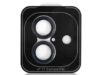

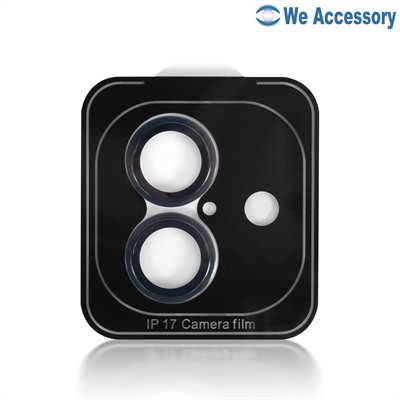
A retailer in Gothenburg sent back a case of camera lens protectors last spring with a note that had one sentence of detail: customers say their night photos have a light spot in them.
Four hundred pieces, all of it one model, all of it unsold. My first instinct was the same as yours would be. A piece of glass in front of a lens, doing nothing, how much harm can it do.
So I took one home and photographed a streetlight, then took the protector off and photographed the same streetlight. Then I did it again with a coated sample from a different factory, and once more with nothing at all. The difference was not subtle. The uncoated sheet had put a bright ghost just below the lamp, and the whole frame was about eight percent darker.
That is what this article is about. For anyone in camera lens protector wholesale, the distinction that matters is that a lens protector is not a screen protector for a smaller screen. It sits in the optical path of the most demanding camera most of our customers will ever own, and it changes that camera’s behaviour in ways you can measure, photograph and put a number on. Most of the category is sold on a claim that it does not affect image quality. Most of the category affects image quality.
I am not writing this to talk you out of the category. Lens protectors carry a better margin per unit than most of what we ship, the attachment rate is rising, and there is a real job for them to do. I am writing it because the eight percent is a purchasing decision, and camera lens protector wholesale rewards the buyer who reads a coating line. Buy the wrong sheet and you sell a product that quietly ruins the thing the customer bought the phone for, and then you find out about it three months later in a returns carton.
Here is the uncomfortable fact that the whole category has to work around. The cover glass on the back of a flagship phone camera is not ordinary glass. On most current models it is sapphire or a hardened crystalline material, and it sits somewhere around nine on the Mohs scale, which is close to the hardest thing a customer will handle in daily life. Sand, grit and keys sit between five and seven.
That cover is there for exactly the reason you are selling a protector. The manufacturer put a scratch-resistant window in front of a lens that costs a meaningful fraction of the phone to replace, and they did it before the phone left the factory.
So the honest pitch in camera lens protector wholesale is not “your lens is unprotected”. It is “the window is hard but thin, it is bonded to a module that is not serviceable in the field, and a crack in it means a camera replacement rather than a glass replacement”. That is a narrower claim and a more defensible one. On the phones I have handled, the cracked camera cover is a real failure, and it usually comes from a corner impact on the raised camera plateau rather than from a scratch.
The second thing worth knowing before you choose a product is that the cover glass is not flush with the lens. It sits above it, and the gap between the cover and the first element is part of the optical design. Every protector adds to that gap, and the gap is the thing that does the damage.
Put a flat plate of glass into a converging beam and the beam does not pass through unchanged. It slows down inside the glass, so the cone of light arrives at the sensor as if it had come from slightly further away. The focus moves.
The size of that shift is easy to calculate, which is why it is strange that nobody in this trade quotes it. It goes as the thickness of the plate times one minus the reciprocal of its refractive index.
| Protector thickness | Focus shift, at n = 1.52 |
|---|---|
| 0.15 mm | about 51 µm |
| 0.20 mm | about 68 µm |
| 0.25 mm | about 86 µm |
| 0.33 mm | about 113 µm |
| 0.50 mm | about 171 µm |
Sixty-eight micrometres does not sound like much, and on its own it would not matter. A phone’s autofocus has far more range than that, and in a normal photograph it simply racks the lens a little and the picture is sharp.
But three things make it matter more than the number suggests.
The first is that autofocus is not free. The system hunts, which takes time and battery, and in low light or low contrast the hunt gets longer and sometimes fails. A protector that shifts focus by a tenth of a millimetre does not break the camera, it makes it slightly worse at the thing it does fifty times a day, and “slightly worse” is what customers report as “the camera is not as good as it was”.
The second is close focus. At macro range the depth of field collapses to a few millimetres, and the autofocus range is at its end. On the ultrawide cameras that double as macro on current flagships, a 113 micrometre shift pushes the whole working range, which is why some phones stop achieving their closest focus with a protector on. The customer does not say “the focus range moved”. The customer says it will not focus on the coffee cup any more.
The third is that the shift is not the only thing the plate does. It also introduces spherical aberration, because the rays at the edge of the cone travel at a steeper angle through the glass than the rays in the middle. That is a blur that no amount of autofocus removes. On a small aperture it is negligible. On the f/1.6 main camera of a modern flagship, which is collecting a very steep cone, it is not.
None of this is visible in a product photograph, and none of it is in the specification, which is exactly why the sector gets away with vague claims about clarity.
Now the number in the title.
Glass at a refractive index of about 1.52 reflects roughly 4.3 percent of the light that hits it at normal incidence. A protector has two surfaces, so if neither is coated, you lose the reflection twice over. Multiply it out and you transmit about 91.7 percent.
| Surface treatment | Reflection per surface | Light transmitted through one protector |
|---|---|---|
| None | about 4.3% | about 91.7% |
| Single layer magnesium fluoride | about 1.3% | about 97.4% |
| Multilayer anti-reflective | about 0.3% | about 99.4% |
Eight percent of the light is a real loss in every photograph, and it is not evenly distributed in the way people assume. It is not simply a slightly darker image, because the phone’s metering will compensate by extending the exposure or raising the gain. What you actually get is a slightly worse signal-to-noise ratio, which shows up as grain in low light and as muddiness in shadow detail. The customer sees a night photo that is soft and noisy compared with the one they took last year with a different case and no protector.
And then the reflected light has to go somewhere. Four percent of a bright source, bounced off a flat surface parallel to the sensor, arrives back at the sensor as a faint image of that source, displaced by twice the gap between the plate and the lens. That is the ghost. It is the light spot in the Gothenburg complaint.
At night the ghost is bright relative to everything around it, because the source is a streetlight and the background is a dark street. Run the numbers: a 4.3 percent reflection against a background that is two percent grey is twice as bright as the background. It reads as a glowing smear that was not in the photograph before, and once a customer has seen it they cannot unsee it.
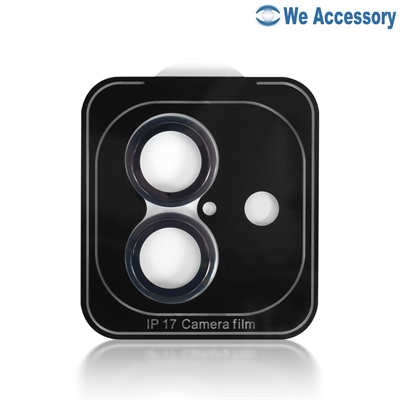
An anti-reflective coating is the single most important line in the specification, and it is the line least likely to appear on a quotation.
A multilayer coating brings reflection from 4.3 percent down to about 0.3 percent per surface. That takes the total loss from 8.3 percent to 0.6 percent, and it takes the ghost from twice the brightness of the night background to well under it. The coating is not a premium feature. It is the difference between a product that is optically acceptable and one that is not.
The catch is that you cannot see a coating. A coated sheet and an uncoated sheet look identical in a photograph and feel identical in the hand, and the cost difference is real, on the order of a few cents a piece. There is one fast tell, and it is worth teaching your counter staff: tilt the protector under a desk lamp and look at the reflection of the lamp in the surface. A coated sheet shows a dim, purplish or greenish reflection. An uncoated sheet shows a bright, colourless one, almost as bright as the lamp itself.
We keep a coated and an uncoated sample in the office specifically for that demonstration, and it has ended more arguments with buyers than any spec sheet.
Half the lens protectors in our catalogue come with an aluminium ring around the glass, and the ring sells, because it makes the product look engineered and it protects the raised lip of the camera plateau.
Optically, a ring is neutral as long as it stays outside the entrance pupil. The moment it intrudes into the field of view, you have vignetting at the corners, and on wide cameras that shows up as darkening that the phone’s software will partially, but not completely, correct. A ring that is 0.2 mm too small on a large camera module is a product that darkens the corners of every photograph, and it will pass every inspection you run because the part is dimensionally correct and the defect is optical.
The second thing a ring does is give light somewhere to bounce. A shiny anodised inner wall reflects light that has already passed the front surface back into the lens, which shows up as a bright arc at the edge of a night frame when a light source is just outside the shot.
The fix is unglamorous: an inner wall that is matte and black, an aperture that clears the entrance pupil with margin on the widest camera, and a dimension on the drawing for both. A ring with a blackened inner face costs almost nothing more to make and removes a whole class of complaints, and no supplier will offer it unless you ask.
There is a third thing the ring does, which is cause the only physical conflict in this category. A protector with a raised ring increases the height of the camera plateau, and a tight camera cutout on a phone case will then either fail to seat or press on the ring. That is a fit problem with its own arithmetic, and I have written about protector and case interference elsewhere, so I will only say here that if you sell both, the ring height belongs in the same conversation as the case cutout.
Our own catalogue copy for the first lens protectors we sold said the product left image clarity intact, with no loss of contrast or sharpness. I wrote a version of that sentence myself in 2020 and I have since taken it out of every listing we control.
It was not a lie in the sense of being knowingly false. It was a claim nobody had tested, copied from the factory’s own material, which was itself copied from a supplier upstream. That is how most of the technical language in this trade is produced: not by measurement, but by transcription with the edges filed off.
What we say now is narrower and it happens to be true, which is a better long-term position. The claim we can support is that the sheet is anti-reflective coated, that transmission is above 99 percent, that the ring clears the entrance pupil of every camera on the listed models, and that the focus shift is published as a figure so the buyer can decide whether it matters for their customers.
That last item is unusual and it is the one I would push for hardest if I were on your side of the table. A focus shift figure is not a boast, it is a disclosure, and a supplier willing to publish one is a supplier who has thought about the optics rather than the packaging.
The old catalogue line quoted 0.2 mm as a selling point, and for lens protectors that instinct is correct, though not for the reason it gives.
A thinner plate shifts the focus less, reflects the same amount per surface, and adds less height to the camera plateau, which helps with phone case fit. The cost of going thinner is mechanical: the sheet has less to give before it cracks, and it is easier to chip at the edge during fitting. Between 0.2 and 0.33 mm the focus shift moves from about 68 to 113 micrometres, which is the difference between “the macro mode still works” and “sometimes it does not”, on the models where the working distance is already tight.
So the useful position is 0.2 to 0.25 mm with a proper coating, rather than 0.33 with none. If a factory offers you 0.5 mm “for extra protection” on a lens, they are selling you a product that protects a lens that is already nine on the Mohs scale, at the cost of 171 micrometres of focus shift and a taller ring. That is the wrong trade for almost every customer.
Not every lens on a phone is equally sensitive, and this is where a distributor can make a real difference to what they stock and what they recommend.
| Camera type | What the protector does to it | How much it matters |
|---|---|---|
| Main wide, f/1.5 to f/1.8 | Steepest cone, most spherical aberration, ghost most visible at night | High |
| Ultrawide, often doubling as macro | Field of view is wide, so a small ring intrusion vignettes; close focus is at its limit | High |
| Telephoto, 3x to 5x | Long focal length, so the focus shift is a smaller fraction of the total, but the aperture is small | Moderate |
| Periscope, folded optics | The path is folded inside the module, so the cover is offset from the entrance; ghosting behaves differently | Variable, test it |
| Front camera | Almost never covered by these products | Not relevant |
The main camera is where the damage shows, because it is the one used at night, and because a large aperture is the least forgiving of a plate in front of it. If you only test one thing before buying a lot, test the main camera at night, with the exposure locked, which is the test camera lens protector wholesale buyers never run.
The periscope row deserves a warning rather than a recommendation. Folded optics put a prism or a mirror inside the module, and a flat plate over the entrance adds a reflection surface that the optical designer never budgeted for. In my experience most periscope phones are fine with a good coated protector, and a few produce a ghost that no coating removes. That is not a defect you can specify your way out of, it is a test you have to run on the actual model.
You do not need an integrating sphere. You need to be able to compare the same scene with and without the protector, which requires locking everything except the protector.
Lock the camera’s exposure and focus. Most phone camera apps have a pro or manual mode; if yours does not, use a third-party app and set ISO, shutter and focus to fixed values. This single step is what makes the test valid, because a camera on auto will compensate for the eight percent and hide it.
Shoot three scenes per protector, and the same three with no protector, in the same session, on a tripod or propped against something solid:
The night ghost test, which is a bright point source against a dark background, shot from about three metres with the room lights off. A street lamp, a bare bulb, or a phone torch at the far end of a corridor all work.
The grey wall test, which is a plain white or light grey surface filling the frame, with the exposure locked. This is the transmission test, and you read it off the histogram rather than by eye.
The close focus test, which is the nearest thing the camera will focus on with the protector off, then the same distance with it on. Note whether it focuses at all, and how long the hunt takes.
| What you record | Protector off | Protector on | How to read it |
|---|---|---|---|
| Mean brightness of the grey wall, locked exposure | baseline | compare | A drop of more than 3% means no coating, or a bad one |
| Ghost visible in the night frame | none | yes or no | Any obvious ghost at 4% is a reject |
| Close focus distance | baseline | compare | If it stops focusing at the original distance, reject for macro users |
| Time to lock focus in dim light | baseline | compare | More than about a second slower is a complaint waiting to happen |
| Corner brightness on the ultrawide | baseline | compare | Visible darkening means the ring is intruding |
Five units per SKU, not one, because the variation between pieces from the same lot is often larger than the difference between two SKUs, and a single sample will let you conclude something confident and wrong.
The whole protocol takes an afternoon for three SKUs and it produces the only document that matters in this category: a set of paired photographs with locked exposure, showing what the customer will actually see.
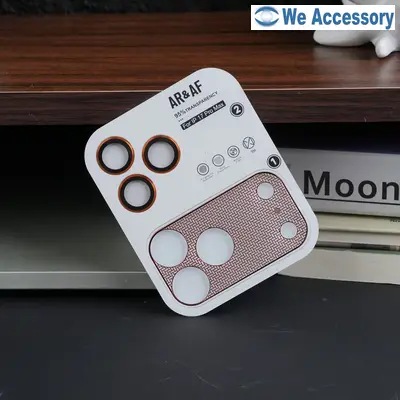
The grey wall number is the fastest filter. If the mean brightness drops by more than three percent, the sheet is uncoated or its coating is single-layer and thin, and you should not be buying it for a customer who photographs anything at night. Three percent is generous; a properly coated sheet should land inside one percent.
The ghost is the second filter, and across all of camera lens protector wholesale it is binary. Either the bright source produces a visible duplicate or flare streak, or it does not. There is no useful middle ground, because the customers who notice will notice it in the first week.
The close focus number is the third, and it is the one that gets ignored because it only affects a subset of users. My view is that it matters more than it looks, because the users it affects are the ones taking photographs of products, documents and food, which in a B2B context is a customer photographing the thing they are about to sell. That customer notices.
The corner test is the fourth and it mostly catches ring design rather than glass. If the ultrawide corners darken, the ring is too small for that model, and the fix is a model-specific ring rather than a different sheet. Do not accept a universal ring on a phone with a large camera plateau; the geometry does not work and the defect is invisible until someone shoots a wide landscape.
Put those four results in a table per SKU and you have something no competitor in this trade is sending to buyers, which is a slightly awkward advantage to have but a real one.
A lens protector costs us between six and twelve cents depending on coating, ring and packing. At retail it sells for anywhere between four ninety and twelve ninety, and it is one of the few accessories where the customer does not comparison shop, because it is bought in the same transaction as the case and the screen protector, at a counter, from a person who says “and you will want one of these”.
| Item | Low end | High end |
|---|---|---|
| Landed cost per piece | €0.06 | €0.12 |
| Retail price | €6.90 | €12.90 |
| Gross margin after fulfilment | about €6.49 | about €9.43 |
| Attachment rate seen at counters | 15% | 45% |
That attachment rate row is the one to watch, and it is not a product property. It is a merchandising property. The difference between fifteen and forty-five percent is whether the protector is on the counter in a tray next to the case, or in a drawer because it is a small item that walks.
Which brings up the reason a cheap lens protector is expensive. A retailer who sells a bad one does not lose the six euros. He loses the customer’s confidence in the three products sold at the same time, one of which is the screen protector with a real margin on it and the other of which is the case. I have watched a whole display lose its credibility over a two-cent coating, and the arithmetic of that is not close.
The catalogue has three families, and they are not the same product.
The plain coated sheet, with or without an aluminium ring, is the working product. One per current model, in the black or the colour that matches the phone.
The ring version with a raised aluminium bezel is the premium one. It protects the camera plateau lip, which is the part that actually takes the corner impact, and it looks like engineering, which sells. Its cost is the fit interaction with cases and the vignetting risk on wide cameras, both of which are manageable if the ring is specified properly.
The decorative versions, the glitter film, the mirror finish, the coloured ring with a pattern, are merchandising products. They sell to a specific customer, they photograph well on social, and they cost you most of the optical performance you just paid for. A mirror finish reflects, by definition. A glitter film scatters. Neither is wrong as a product, both are wrong as a default recommendation, and the mistake I see is a distributor who stocks only the decorative family because it photographs better in the trade catalogue.
The model coverage question has an easy answer for once. Lens protectors are a small, light, cheap part with no adhesive cutouts and no screen-to-body geometry, so the tail is unusually long. A two-year-old mid-range model is still worth carrying, which is the opposite of what is true for cases. If you are building a range, the rule I would use is one piece per model for every phone sold in your market in the last thirty months, and accept that half of them will sit.
Coating specification, as a type rather than an adjective: multilayer anti-reflective, with a stated transmission figure and a test method. “Coated” on its own means nothing.
Thickness, with a tolerance, and the resulting focus shift stated. If the supplier cannot compute the shift, he can at least state the thickness precisely, and you can compute it yourself in ten seconds.
Ring material and inner-wall finish. Aluminium is fine, a matte black inner wall is required, and both belong on the drawing.
Entrance pupil clearance per listed model, with the widest camera named. This is the line that prevents the corner darkening, and it has to be per model because the plateaus differ.
Ring height above the glass, because it determines whether your cases fit. This is a cross-category specification and it belongs in both the case and the protector order.
Adhesive type and a statement on residue, because a lens protector that leaves glue on a sapphire cover is a problem the customer cannot fix.
Packing, including whether pieces are separated, and a carton drop test with a stated break criterion.
Batch traceability and a coating lot number, because when a retailer reports a ghost you will want to know whether it was one lot or the whole design.
A screen protector can go on crooked and still work, because the panel is large and the outline has slack. A lens protector has no slack. The window it covers is often under twenty millimetres across, the entrance pupil sits inside it with a clearance of a millimetre or two, and the same millimetre of misalignment that is invisible on a screen is a tenth of the aperture here.
Two consequences follow, both of them practical. The first is that a hand-fitted lens protector will sometimes clip the edge of the widest camera’s field, which shows up as a dark wedge in one corner of an ultrawide shot and nowhere else. The second is that the sheet sits off-centre on the ring, so one side of the adhesive has load on it and the other does not, which is where lifting starts on a hot day.
A positioning sticker or a drop-in applicator tray is the cheap fix, and it is the reason the catalogue carries a version with the sticker. It costs a fraction of a cent and it moves the failure from the customer’s hand to the factory’s tooling, which is where it should be. If you buy a lens protector without one, you are asking a shop assistant to be accurate to a tenth of a millimetre with his thumb.
Two lens protectors for the same phone, one quoted at four point two cents and one at nine point five, both described the same way in the email. Here is what is inside each of them, at a hundred thousand pieces.
| Line | Four-cent version | Nine-cent version |
|---|---|---|
| Glass blank, 0.33 mm, cut to size | 0.012 | 0.012 |
| Anti-reflective coating | none | 0.024 |
| Ring | steel, bright, universal | aluminium, blackened inner wall, per model |
| Ring cost | 0.008 | 0.019 |
| Ring tooling, amortised | 0.001 | 0.006 |
| Adhesive and liner | 0.003 | 0.003 |
| Packing | poly bag | tray and card |
| Packing cost | 0.004 | 0.009 |
| Labour and final inspection | 0.005 | 0.010 |
| Total | 0.033 | 0.083 |
The five-cent difference is almost entirely two lines: the coating at 2.4 cents, and the ring at 1.9 cents plus its tooling. Everything else is a rounding error.
Now put that next to the consequence. Five cents a piece on a thousand-piece order is fifty euros. One retailer who gives up on the category because the night photos looked wrong costs you the lens protector margin on every phone he sells, plus the screen protector that goes with it, plus the phone case. At the attachment rates in this article, that is not fifty euros, it is a number with three digits in it.
There is a fair version of the counter-argument, and I want to state it because it is true. If you are selling to a market that replaces lens protectors weekly, or to a channel where the product is a giveaway, the four-cent version has a place, and the optics are not the constraint. The mistake is stocking it as the default and hoping nobody photographs a streetlight.
The other place the arithmetic surprises buyers is the mixed order. Lens protectors look like a simple part, and the glass is, but the ring is not: a ring that clears the entrance pupil has to be sized to the camera plateau, and the plateaus differ between models. So a range of twelve models can mean twelve ring tools, or it can mean four, depending on how you consolidate.
| Approach | Ring tools | Tooling cost at $180 each | Amortised over 6,000 pieces |
|---|---|---|---|
| One ring per model, 12 models | 12 | $2,160 | $0.36 per piece |
| Four ring families across 12 models | 4 | $720 | $0.12 per piece |
| One universal ring | 1 | $180 | $0.03 per piece, with vignetting risk |
The middle row is where most sensible ranges end up, and the saving against the top row is twenty-four cents a piece, or about fourteen hundred dollars on a six-thousand-piece order. That is more than the coating decision, and unlike the coating it costs you nothing in optical quality, provided the four families are chosen so that every model’s widest camera still clears.
The bottom row is the one that produces the complaint, and it is worth being explicit about why a distributor takes it anyway. One universal ring means you can add a model to the range without tooling, so the marginal cost of covering a new phone is zero, which is irresistible when you are trying to keep a long tail alive. The right answer is probably a universal ring for the tail and sized rings for the models that sell, which is also the answer I would give for phone cases in general, and I know how unglamorous it sounds.
We sold an uncoated lens protector for about two years, in good faith, on the strength of a sentence in a factory brochure. When the Gothenburg returns came in I did not believe the customer, I believed the brochure, which is a bad habit dressed up as supplier loyalty. The coating was three cents a piece. We lost a four-hundred piece order, a retail account, and about a year of margins on the screen protectors that account used to buy.
The second mistake was smaller and more embarrassing. We added an aluminium ring to the whole range because it looked better, and we made it 0.15 mm smaller in the aperture to save on material. The corner vignetting that produced was invisible in every product photograph, passed every dimensional check, and showed up on the ultrawide camera of one model out of nine. We did not find it, a photographer customer did, and he was polite about it in a way that made it worse.
Both mistakes had the same cause, which is that we were evaluating the product with our eyes at the counter rather than with the camera it was going to sit in front of. The test in this article costs an afternoon. The two mistakes cost more than that.
What is the coating, specifically, and what transmission does the sheet achieve. If the answer is a number, ask how it was measured.
What is the entrance pupil clearance on the widest camera of each listed model, and is the ring sized per model or universal. Universal is not automatically disqualifying, it is just a thing you should know.
Is the inner wall of the ring matte and black. If the answer is no, ask what colour it is.
What is the ring height above the glass, and has it been checked against the cases you sell. This is the question that saves the fit complaints, and almost nobody asks it.
Can I have paired photographs, with locked exposure, of a night scene with and without the protector. A supplier who can send that is a supplier who tests.
What happens if a retailer reports ghosting on a lot. Not the warranty language, the actual process and the timescale.
Six questions. Only two of them are about price, and all six of them will change it, because a coated sheet with a blackened per-model ring is a different product from an uncoated universal one, and the difference is worth more than the cents.
Three pieces sit next to this one without repeating it. The thickness question, why 0.33 mm and 0.50 mm are different products with the same label, is here: Screen Protector Wholesale, Why 0.33 mm and 0.50 mm Are Not the Same Product. The coating that wears off long before the glass breaks is here: The Coating Nobody Sees. And why the same protector costs more for an old phone than a new one is here: Why the same screen protector costs more for an old phone.
The lens protectors themselves, with the coating type and the ring spec listed per model instead of a claim about clarity, are on the iPhone screen protector wholesale page and the wider screen protector wholesale page.
We Accessory has supplied tempered glass screen protectors, camera lens protectors and phone cases to wholesalers, repair chains and private-label brands since 2012. Our lens protectors are multilayer coated as standard, the ring is sized per model and blackened on the inner wall, and we will send you the paired night photographs and the transmission figure for the lot you are buying.
If you have a shelf of lens protectors that keep coming back with “photos look worse”, send us the model list. We will test the ones you have and tell you which of them are costing you the screen protector sale, including when the answer is that ours would too.
Address: 2F, Block A2, Nanchang Industrial Area, Xixiang Town, Bao’an District, Shenzhen, China Tel: +86-755-36818832 WhatsApp: +86-15919800304 Email: [email protected] Web: weaccessory.com
— William Shaw, Head of Sales at We Accessory
For iPhone screen protectors and the wider screen protector wholesale range, the category pages list every model with its coating and edge specification.
Camera lens protectors buyers order most
Address:2F, Block A2, Nanchang Industrial area, Xixiang Town,Bao'an District, Shenzhen
Tel: +86-755-36818832
Mobile/Whatsapp: +86-15919800304
Email: [email protected]


