 English
 Français
 Deutsch
 Español
 Italiano
Address:2F, Block A2, Nanchang Industrial area, Xixiang Town,Bao'an District, Shenzhen
Tel: +86-755-36818832
Mobile/Whatsapp: +86-15919800304
Email: [email protected]


A webshop in Utrecht sent back three thousand clear cases in June, six weeks after they went on sale, with one sentence and a photograph of a case next to a sheet of white paper.
The sentence said the cases had turned yellow. The photograph did not show anything dramatic. The case was not brown, it was not opaque, it simply had that faint amber cast that a clear case gets, and beside a piece of white paper it looked like a used product.
I pulled the invoice for that SKU, because I wanted to see what we had sold them. The material line said TPU, and the note beside it said UV stabilised.
That note is where the whole problem lives, and it is where most of this trade’s understanding of the category goes wrong. UV stabilised sounds like the answer to yellowing. In practice it is a description of a small additive package inside a polymer whose molecular structure is the actual cause, and an aromatic polyurethane with a UV absorber in it is still an aromatic polyurethane. It yellows. It just yellows a little later, which in a retail context is the same complaint with a longer lead time.
This article is about the root of the problem rather than the symptom. Why clear TPU goes yellow, why the additives cannot stop it on their own, and why the only fix that survives a full summer is a decision made at the pellet rather than at the additive feeder.
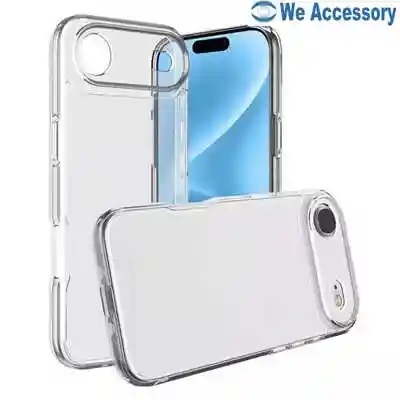
A clear phone case does not lose its colour. It gains one.
Polyurethane is a chain of soft and hard segments, and in an aromatic grade the hard segment contains benzene rings. Those rings absorb ultraviolet light, and when they do, the energy has to go somewhere. It goes into chemical bonds, and the products are new structures with conjugated double bonds: quinone-imides, azo compounds, and carbonyl groups formed where oxygen has attacked a chain.
Conjugated structures absorb visible light, and specifically they absorb at the blue end. A material that absorbs blue looks yellow, because the light that comes back to your eye is everything except blue. That is the whole optical story. The case is not dirty and it is not coated with something; it has developed chromophores, and they are part of the polymer now.
Which is why no cleaning product fixes a yellowed phone case, and why the discolouration is permanent in a way that a scratch is not.
The rate depends on three things: how much UV reaches the material, how much oxygen is available, and how susceptible the specific chemistry is. Of those three, the third is the one that decides whether a case lasts six weeks or two years, and it is decided by the resin, not by the additive.
Polyurethanes come in two families that look identical in a pellet bag and behave completely differently in sunlight.
Aromatic TPU is built on MDI or TDI, both of which contain a benzene ring in the isocyanate. It is cheap, it is strong, it bonds well, and it is what most clear cases in the world are made of. It is also the reason most clear cases in the world go yellow, because the benzene ring is the chromophore’s starting point. Light hits the ring, the ring opens into a quinone-imide, and the material starts absorbing blue.
Aliphatic TPU is built on HDI or IPDI, which have no aromatic ring. There is nothing for the UV to convert into a chromophore in the same way, so the yellowing rate is dramatically lower. Aliphatic TPU does eventually change, everything does, but it holds its colour through a summer rather than through six weeks.
The price difference is the reason this is not the default. Aromatic TPU runs around three dollars a kilo; aliphatic runs around eight. On a twenty-eight gram case that is eight cents against twenty-two, a difference of about fourteen cents on a case that sells for sixty-two.
| Resin | Price per kg | Resin cost per 28 g case | Yellowing in a summer |
|---|---|---|---|
| Aromatic TPU, MDI based | about $3 | about $0.084 | Almost always, visibly |
| Aromatic TPU, film grade | about $4 | about $0.112 | Yes, slightly slower |
| Aliphatic TPU, HDI based | about $8 | about $0.224 | Minimal over one season |
| TPE, no urethane at all | about $2.5 | about $0.070 | Very little, but feels different |
Read the last row, because it is the honest alternative. TPE, meaning a styrenic block copolymer rather than a polyurethane, does not have the urethane chemistry that produces the aromatic chromophore, and it holds clarity well. What it gives up is hand feel and rebound, which is why a clear case made of TPE feels slightly rubbery and less crisp than TPU. Some customers notice; most do not. If your market is price-led and clear, TPE is a more honest product than aromatic TPU with a UV absorber in it.
The fourteen cents is the entire argument of this article, and I will come back to it when we get to the additive arithmetic, because it is where the money actually goes.
Here is the part that surprises even people who have been buying compound for years.
Most polymers contain an antioxidant, and the cheapest and most common class is the hindered phenol: BHT, or Irganox 1010, or one of their relatives. They work by donating a hydrogen to a radical and stopping the chain reaction, and they are very good at it.
Their own oxidation products, unfortunately, are quinones and quinone methides, which are yellow to red. So a phenolic antioxidant protects the polymer from degradation and, in the process, gradually contributes colour of its own. In white or clear material this shows up as a yellowish or pinkish cast that appears even in the dark, without any UV at all.
Then there is the reaction that produces the classic “pinking” of stored white plastics: phenolic antioxidant plus oxides of nitrogen from the air, from exhaust fumes, from a warehouse next to a road, gives a coloured quinone. Cartons stored in a warehouse near a busy street can develop it without ever being exposed to sunlight.
The practical consequence is that “UV stabilised” can describe a package that is doing two contradictory things: absorbing UV with one additive while generating colour with another. A well-built compound avoids this by using a phosphite as the secondary antioxidant, which decomposes peroxides without producing coloured byproducts, and by choosing a phenolic only where its colour contribution is acceptable.
Almost no quotation will tell you this. A compound datasheet will list “antioxidant: 0.1%” and stop there.
Now the additive that everyone points to, and the reason it is necessary but not sufficient.
A UV absorber works by absorbing ultraviolet light before it can reach the polymer chains, and it is genuinely effective. You can calculate how effective, because it obeys the Beer-Lambert law: absorbance rises with concentration and with path length, and transmission falls exponentially.
Take a typical benzotriazole absorber, with a molar extinction of about fifteen thousand at 340 nanometres, a molecular weight of 350, and a loading of 0.3 percent in a TPU with a density of 1.2.
| Loading | UV transmission through 0.05 mm | through 0.10 mm | through 0.20 mm |
|---|---|---|---|
| 0.1 % | 55 % | 31 % | 9 % |
| 0.2 % | 31 % | 9 % | 0.9 % |
| 0.3 % | 17 % | 2.9 % | 0.08 % |
| 0.5 % | 5.2 % | 0.27 % | 0.0007 % |
At 0.3 percent, a tenth of a millimetre of material already stops ninety-seven percent of the UV at that wavelength. Doubling the loading to 0.5 percent takes the remaining transmission from 2.9 percent to 0.27 percent, which is a tenfold improvement on a number that was already tiny.
Which tells you something important about the limits of the additive approach. The surface of the case is already close to fully screened at normal loadings. Adding more absorber buys almost nothing, because there is almost nothing left to absorb. The yellowing that still happens is coming from chemistry the absorber cannot reach: the aromatic ring in the polymer itself, the antioxidant byproducts, thermal history, and nitrogen oxides from the air.
That is why, in clear phone case wholesale, a product can be described as UV stabilised, pass a UV screening calculation, and still be visibly yellow in August.
Ranked by what they buy you, here is where the money goes.
The resin, first and by a wide margin. Aliphatic instead of aromatic is the single change that turns a six-week product into a season-long one. Nothing else comes close, and nothing else can compensate for it.
The antioxidant system, second. Phosphite instead of, or alongside, a phenolic. No BHT in a clear part. This is cheap and it prevents the dark-storage yellowing that has nothing to do with sunlight.
The light stabiliser package, third. A UV absorber at 0.2 to 0.4 percent plus a hindered amine at 0.1 to 0.3 percent. The amine is the one that handles the surface, where the absorber has done its work and the radicals are still being generated.
Process control, fourth. Dry the resin properly, keep the melt temperature inside the window the datasheet gives, and do not let material sit in the barrel. Over-dried or over-heated resin arrives at the mould already slightly coloured, and no additive added afterwards removes that.
The ester or ether question, fifth, and specific to humidity. Polyester-based TPU is stronger and yellows similarly, but it hydrolyses in warm humid conditions, and a clear case that has hydrolysed goes cloudy as well as yellow. Polyether-based TPU resists hydrolysis better. If you are selling into a humid market, this matters as much as the UV package.
Here is the number that makes the case for the raw material approach better than any chemistry lesson.
A full additive package, meaning a UV absorber at 0.3 percent, a hindered amine at 0.2 percent and a phosphite at 0.1 percent, comes to about half a percent by weight of the compound. On a twenty-eight gram case that is 0.14 grams of additive. At a blended price of roughly twenty-five dollars a kilo for the package, that is three and a half thousandths of a dollar per case.
Three and a half tenths of a cent.
Against fourteen cents for the step from aromatic to aliphatic resin.
| Cost line | Per case | Share of the resin premium |
|---|---|---|
| Full additive package at 0.5 % | $0.0035 | 2.5 % |
| Aromatic to aliphatic resin | $0.140 | 100 % |
| Total if you do both | $0.1435 | — |
The additive package is two and a half percent of the resin decision. Which means two things at once.
The first is that the additives are almost free, so there is no excuse for a clear case without a proper package. Three tenths of a cent is not a cost conversation.
The second is that the additives cannot be the fix, because the thing they would have to fix costs forty times more than they do. A supplier who is asked to solve yellowing will reach for the cheap lever, because the cheap lever is the one he can pull without changing the price. That is why the market is full of aromatic TPU that is described as UV stabilised, and why it still goes yellow.
If you want a clear case that survives a summer, the conversation has to be about the pellet, and it has to happen before the price is agreed, because the fourteen cents lands in the price and the additive does not.
The phrase appears on compound datasheets in several different meanings, and almost none of them mean what a buyer assumes.
The weakest version means a UV absorber was added, at a low loading, to an aromatic TPU. It will slow the yellowing. It will not stop it, and the datasheet often quotes a UV exposure figure measured on a thin film, which is not the geometry of a case.
The middle version means a UV absorber plus a hindered amine, sometimes with a phosphite, still in aromatic resin. Better, and worth having, and still an aromatic polymer underneath.
The strongest version says the base resin is aliphatic, and then lists the package. That is the one to buy.
There is a fourth version, which is a marketing sentence rather than a datasheet line: “anti-yellowing material”. It usually means one of the three above, and the only way to find out which is to ask for the resin type. A supplier who can name the isocyanate, MDI or HDI, has answered the question. A supplier who cannot has told you something too.
Our own materials guide, written last year, says that UV stabilised TPU costs ten to twenty percent more and extends yellowing resistance from four to eight weeks out to six to twelve months.
The cost figure is roughly right. The performance figure is the industry’s line rather than a measurement, and I have since seen enough six-week failures in “UV stabilised” aromatic TPU to stop repeating it.
What the evidence supports is narrower: UV stabilisation slows the yellowing of aromatic TPU and does not prevent it, and the extension depends on the UV dose the case receives, which depends on where it is used. A phone case that lives in a pocket and a bag yellows more slowly than one on a car dashboard. A case in Spain yellows faster than the same case in Finland. A single months figure for the whole of Europe is not a specification, it is a hope.
I would rather say what can be defended: aliphatic resin with a proper package holds colour through a summer in normal use; aromatic resin with a package will show visible change within one season in most of the markets we ship to, and sooner if the case is left in sunlight.
Five lines. None of them are exotic and all of them are usually absent.
Resin chemistry, named. Aliphatic polyurethane, HDI or IPDI based, polyether rather than polyester if the market is humid. If the answer is “TPU”, ask again.
The additive package, itemised. UV absorber type and loading, hindered amine type and loading, antioxidant type, and explicitly no BHT. A supplier who cannot list these is buying compound rather than specifying it.
A colour target in numbers. The yellowness index of the moulded part at zero hours, and the maximum permitted change. Something like YI below 3 at moulding and a change of no more than 5 after the agreed ageing test.
The ageing test, with a duration that means something. A UV test at 340 nanometres for 300 to 500 hours, plus a thermal test at 80 degrees for 168 hours, plus, ideally, a nitrogen oxide exposure, because the NOx yellowing is the one that happens in a warehouse.
A statement of what happens if a lot fails in the field. Not the warranty wording, the process, because the failure appears in month two and the container is long gone.
You cannot run a 500 hour UV test in your office. You can do three things that are almost as useful.
The first is a comparative windowsill test. Take one known-good clear case, one candidate, and a sheet of white paper. Put them on a south-facing windowsill, indoors, behind glass, and photograph them together once a week for six weeks with the same camera and the same light. Glass blocks most UVB and passes UVA, which is roughly what a shop window does, and six weeks of that is a genuine screening test for the aromatic grades, which will show a difference within two or three.
The second is the heat test. A clear phone case in a closed car on a sunny day reaches seventy degrees, and a week of that on a dashboard will bring out thermal yellowing and any antioxidant colour contribution. This is also the test that catches a phenolic antioxidant problem, because that discolouration appears with heat and oxygen but no UV at all.
The third is the comparison nobody runs and everybody should, which is against a white card and a second clear object. Yellow is hard to judge in isolation and easy to judge next to white paper and a piece of known-clear acrylic. Put all three in one photograph and the difference is obvious in a way that a single case never is.
| Test | What it catches | Time | Cost |
|---|---|---|---|
| Windowsill, comparative | Aromatic UV yellowing | 3 to 6 weeks | Nothing |
| Dashboard or closed car, 1 week | Thermal yellowing, antioxidant colour | 1 week | Nothing |
| 80 °C oven, 168 h | Thermal and antioxidant | 1 week | Nothing |
| Lab QUV 340 nm, 300 to 500 h | Everything photo-oxidative | 2 to 3 weeks | A lab fee |
| NOx exposure | Warehouse pinking | 1 to 2 weeks | Rarely available |
Clear is the largest single colourway in the category. It is the default for a phone whose own finish is worth showing, it photographs well, and it is the one product where the customer has an expectation they can state out loud: it should stay clear.
That expectation is also the reason a clear case is the easiest product in the range to lose a customer with, because the failure is visible, gradual, and impossible to argue about. Nobody returns a clear case on day one. They return it in week eight, having watched it change, and by then they have formed an opinion about your range rather than about that SKU.
The commercial answer is not to promise more. It is to price honestly. A clear phone case that holds its colour costs about fourteen cents more in resin, so it should sell for one to two euros more at retail, and a distributor who cannot get that price is competing with a product that will fail in eight weeks and take the account with it.
There is a middle path that is worth offering: sell the aromatic clear case as the volume product and be straight that it will develop a cast over a season, and sell the aliphatic one as the case for customers who keep their phones for three years. Both are honest. What is not honest is selling aromatic resin with a UV absorber in it as anti-yellowing, which is what the phrase on most boxes effectively does.
There is a pricing detail that decides whether the honest version is commercially possible. A clear phone case at retail sits in a narrow band, typically between nine and twenty euros, and the customer compares on appearance rather than on specification, because appearance is all a clear product has. That means the aliphatic version has to look better than the aromatic one on the shelf, which it does only when they are side by side. A distributor who stocks both, puts them adjacent, and lets the shop assistant point out the difference, sells the more expensive one about a third of the time. A distributor who stocks only the cheap one sells it every time until August.
That is the whole commercial argument in clear phone case wholesale, and it is why the category has a reputation problem rather than a pricing problem. The product that fails does not damage the price of the good one, it damages the credibility of the whole section, and the shop that has had to talk a customer through yellowing twice stops stocking clear cases at all.
The failure does not always wait for a customer, and the version that happens in a warehouse is the one distributors notice first and understand last.
Two mechanisms are at work while stock sits. The first is light, if the cartons are near a window or a translucent roof. Polypropylene and cardboard do not block UV completely, and a pallet that sits in a bright warehouse for four months receives a meaningful dose without ever being opened.
The second is the one that surprises people: nitrogen oxides and phenols. A warehouse near a road, or one that shares air with a workshop running engines or gas heaters, carries a small background of nitrogen oxides, and those react with a phenolic antioxidant in a clear polymer to produce a coloured quinone. The result is a yellowish or pinkish cast that appears in the dark, and it appears first on the units nearest the outer surface of the pallet, which is exactly where the buyer inspects.
| What you find in the carton | What it points to | What to check |
|---|---|---|
| Yellow only on the pallet’s outer layer | NOx or light exposure in storage | Warehouse location, roof type, distance from the road |
| Yellow throughout, evenly | Resin or antioxidant problem | The pellet grade and the additive list |
| Warm or pinkish cast, no sun exposure | Phenolic antioxidant plus NOx | Whether BHT or a hindered phenol is present |
| Edges amber, back clear on a hybrid | Aromatic TPU edge, PC back | Which part of the product is which resin |
The storage half of this has cheap answers. Clear stock stored in the dark, away from the outer wall, with cartons closed rather than stacked open, and rotated so that nothing in a clear grade sits for a year. The material half has the expensive answer, which is the pellet.
A distributor who has been blaming the customer for yellow cases should look at his own back room first, because a pallet bought in March and sold in July has had four months of whatever the building offers.
Every distributor with a clear section eventually has a pallet of stock that is no longer clear, and the decision is unglamorous.
Sorting by eye does not work well, because the change is subtle in isolation. Sort by comparison instead: put every unit beside a new reference piece under the same light and grade into three piles, indistinguishable, visible but saleable at full price to a customer who will not compare, and clearly amber. The second pile is the dangerous one, because it will be returned by exactly the customer who compares, which is the customer worth keeping.
The second pile usually becomes a bundle item or a promotional colourway rather than a full-price SKU. The third pile goes to the discount channel or to a market with lower expectations, and it should never go back into a clear range.
There is one thing worth doing before any of that, and it takes twenty minutes: photograph the pallet, with a reference piece and a white card in frame, and send the photograph to the supplier with the lot code. If the resin was aromatic and the invoice said UV stabilised, that photograph is the entire argument, and it is much stronger than a written claim that the product went yellow.
A clear case is not one product, and the yellowing behaves differently across the family. If you are building a clear range, the differences decide which SKUs to bring and which to leave.
The plain clear TPU case is the baseline, and it is the one where the aromatic question matters most, because there is nothing else in the product to hide a change behind.
The clear case with a PC back and TPU edges, the hybrid, fails in a more complicated way. Polycarbonate does not yellow by the same mechanism, it yellows by a photo-Fries rearrangement that turns the carbonate linkage into a coloured structure, and it is slower than aromatic TPU but not immune. The common outcome is a case whose back stays clear while the edges go amber, which looks like a manufacturing defect and is actually two different ageing rates in one product.
The clear case with a coloured bumper hides the edge yellowing behind the colourant and shows it only on the clear back. This is the SKU that generates the fewest complaints while being exactly as susceptible, which is worth knowing when you decide what to photograph for the catalogue.
The clear MagSafe case adds a magnet array and a ferrite sheet behind an opaque disc, and the clear window around that disc is small and mostly out of the sun. It ages better than a plain clear case for reasons that have nothing to do with chemistry.
The clear case with a soft-touch coating on the inside is the worst combination available, and it appears in premium ranges. The coating is a thin polymer layer over clear TPU, it ages at its own rate, and a coating that yellows over a substrate that does not produces a cloudy haze rather than a clean amber. Customers describe it as the case going dirty, and no amount of cleaning helps.
Which produces a stocking rule I would give any distributor building a clear section: one plain clear, one hybrid, and one clear with a coloured bumper, each in the aliphatic grade, and be explicit in the catalogue about which of them is expected to hold colour longest. Three honest SKUs outperform twelve where half of them will be returned in August.
For a clear phone case, yellowing is judged relative rather than absolute, and the relativity is what makes the conversation difficult.
Nobody looks at a clear phone case alone and decides it has gone yellow. They look at it against white paper, against a new case in a shop, or against the case they bought for their last phone. In all three comparisons the change is obvious, and in none of them does a colour scale enter the conversation.
That is why the only demo worth running at a counter is a comparison. Keep a piece of white paper, a small offcut of clear acrylic or polycarbonate, and a brand new case of the same SKU behind the till. Put the customer’s case on the paper next to the new one. The difference is visible in about a second, and it converts an argument into a demonstration.
There is a second thing worth showing, and it is the one that builds trust rather than losing a sale. Hold the case up against the light and look along the edge. An aliphatic case that has aged shows a uniform slight change; an aromatic case that has aged shows a gradient, darkest at the surfaces that faced the sun. That gradient is the fingerprint of photo-oxidation, and once a customer has seen it they understand what they are looking at for the rest of their life.
None of this sells more cases today. All of it is why a customer comes back to the shop that showed them rather than to the marketplace listing that said anti-yellowing.
We bought “UV stabilised TPU” for two seasons because the phrase was on the datasheet and the price was close to plain TPU. What we were buying, as it turned out, was aromatic resin with a small absorber loading, and the returns arrived on schedule in week six. The word stabilised did the work that a resin name should have done, and we let it.
The second mistake was quieter and more expensive in the long run. When we moved to aliphatic, we kept the same additive package, including a phenolic antioxidant, and we spent a year chasing a slight warm cast that appeared in cartons stored in a warehouse near a road but never in the shop. That was not UV yellowing. It was phenolic antioxidant plus nitrogen oxides, and the fix was the phosphite that our compounder had offered and we had declined because it cost a little more.
Both mistakes have the same shape: we specified a product by an adjective rather than by a chemistry.
There is a third, smaller error worth naming because it cost us a season. We assumed that a clear case sold into Scandinavia was a low-risk product because the sun is weak there, and we stocked it accordingly. The case still yellowed, because the mechanism in a pocket is driven by body heat and oxygen as much as by sunlight, and because the warehouse where it was stored had a translucent roof and a main road outside. The climate a case is sold in is not the climate it ages in, and a specification built on latitude will be wrong in both directions.
What is the isocyanate, MDI or HDI, and is the polyol polyether or polyester. The first answer decides whether the product is anti-yellowing at all.
List the additive package: absorber type and loading, amine type and loading, and which antioxidant. If the answer is a single percentage, ask for the breakdown.
Is there any phenolic antioxidant in the formulation, and if so, which one. BHT in a clear part is a slow yellowing agent and it has no place there.
What is the yellowness index at moulding, and what change is permitted after your ageing test. Numbers, not adjectives.
Which ageing tests do you run, at what duration, and against what acceptance criterion. If the answer is a UV test on film, ask for a test on a moulded part.
What happens if a lot turns yellow in the field, and has that happened to another customer in the last two years. The second half is the question that produces a useful answer, because almost every factory has had one.
The materials survey that this article goes deeper on, including TPE and the hybrid construction, is here: Various Phone Case Materials Guide. The price ladder, what a sixty-cent case and a one-eighty case actually contain, is here: The $0.60 Phone Case and the $1.80 Phone Case.
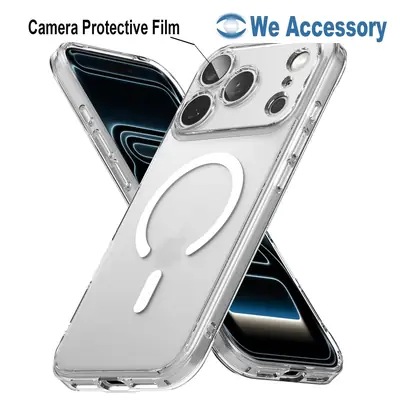
The clear ranges themselves, with the resin type and the additive package listed per model rather than the word “anti-yellowing”, sit on the phone case wholesale page and the iPhone case wholesale page.
We Accessory has supplied phone cases to wholesalers, chains and private-label brands since 2012. Our clear ranges are aliphatic TPU, polyether based, with a stated UV absorber and hindered amine package and no phenolic antioxidant, and we will send you the resin grade and the additive breakdown with the sample rather than a claim on the box.
If you have a clear case that has gone amber and a supplier who says that is normal, send us a piece and the model. We will compare it against a known-good clear under the same light and tell you whether the resin was the problem, the package was the problem, or the product was simply sold with a promise the material could not keep.
Address: 2F, Block A2, Nanchang Industrial Area, Xixiang Town, Bao’an District, Shenzhen, China Tel: +86-755-36818832 WhatsApp: +86-15919800304 Email: [email protected] Web: weaccessory.com
— William Shaw, Head of Sales at We Accessory
For the full range see phone case wholesale and iPhone case wholesale, where the clear models are listed with their resin grade rather than the word anti-yellowing.
Clear cases buyers order most
Address:2F, Block A2, Nanchang Industrial area, Xixiang Town,Bao'an District, Shenzhen
Tel: +86-755-36818832
Mobile/Whatsapp: +86-15919800304
Email: [email protected]


